
Lead the Future of Inclusive Education
The program provides advanced course work in the education of learners with exceptional needs. Program options permit concentrated study in one of two areas: Learners with Mild/Moderate Educational Needs and Learners with Moderate/Intensive Educational Needs. While both concentrations include course work and fieldwork that may be applied toward Ohio licensure as an Intervention Specialist, eligibility for such licensure may require further study, depending on the student’s previous educational background.
If courses were taken previously as part of a Cleveland State baccalaureate degree program, special education courses generally need not be repeated. However, students need to select appropriate graduate elective offerings in consultation with an academic advisor to make up the requisite number of credit hours for the desired concentration. The College of Public Affairs and Education is committed to preparing special educators to work within diverse educational settings and communities.
The Moderate/Intensive Intervention Specialist concentration prepares teachers and professionals from related disciplines to work with children and youth ages 5 through 21 who have moderate to intensive intellectual and developmental disabilities; severe emotional disorders; and/or multiple disabilities. The Mild/Moderate Intervention Specialist concentration prepares teachers and professionals from related disciplines to work with children and youth ages 5 through 21 who have specific learning disabilities, behavior disorders, and/or other health impairments.
With additional licensure-related courses, this degree may lead to an Ohio Intervention Specialist license.




Time to Complete
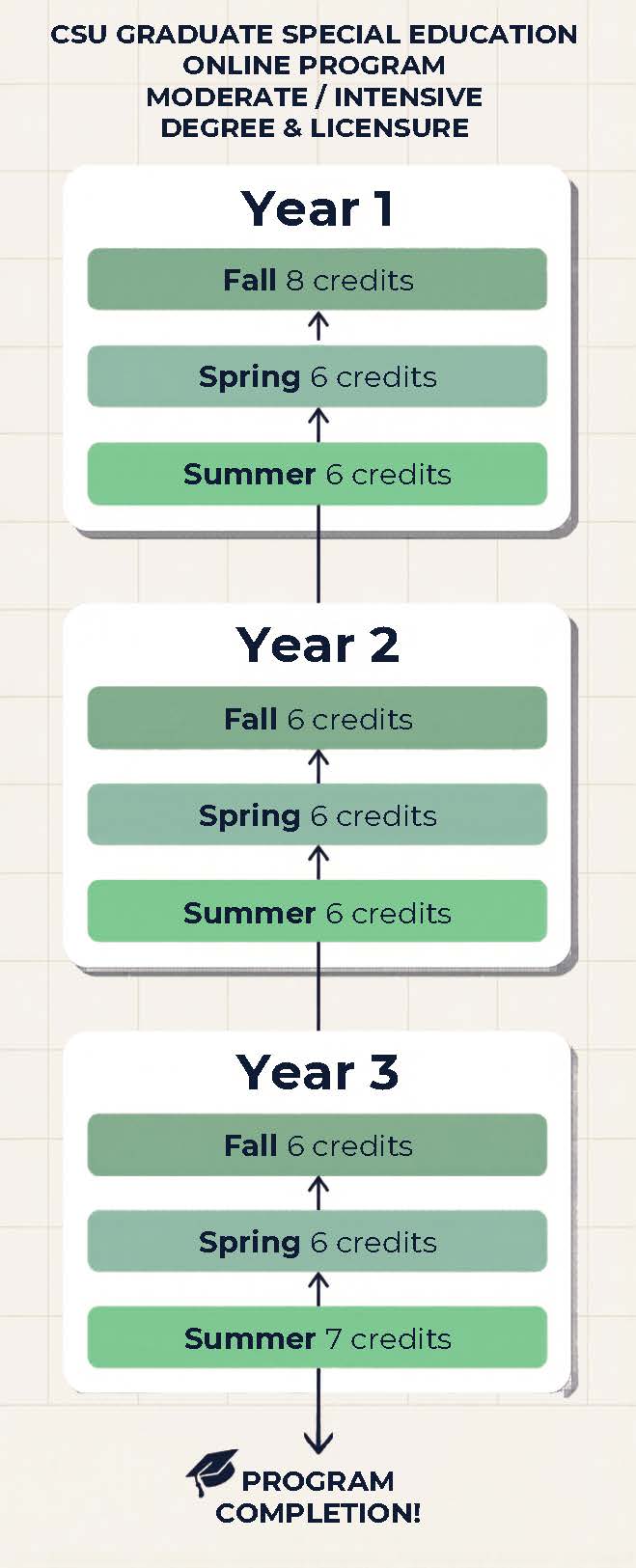
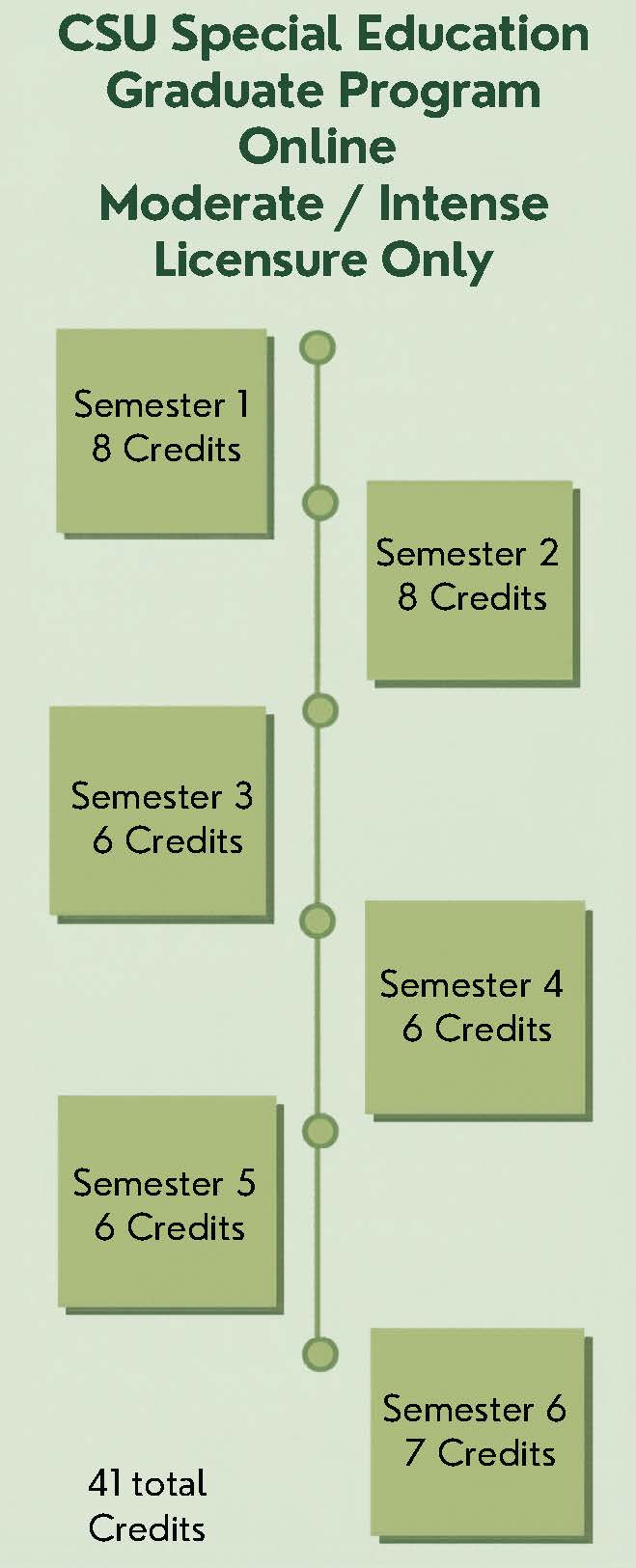

Credits
36 credit hours. 30 minimum required for degree

Why Choose CSU?
- IMTSS foundations, assessment-based planning, collaboration with families and professionals, and disability-specific assessment and instructional methods.
- Internship experiences include a structured placement providing supervised teaching in classrooms with students with mild to moderate educational needs.
- Courses in reading instruction, literacy development, social foundations, and child development to help round out teacher preparation.
- Design, implement, and progress monitor individualized education plans (IEPs)
- Support students with specific learning disabilities, behavioral challenges, and social adjustment needs
- Collaborate with families and school professionals across general and special education settings
- Practice responsive, restorative, inclusive teaching that strengthens outcomes for students with disabilities
- Stackable credentials such as Twice-Exceptional, Gifted, and/or TESOL Endorsements


Learning Methodology
Earn a degree in special education and an Ohio intervention specialist license through our online Master’s in Curriculum and Instruction Cross-Categorical Special Education program. Take courses and learn on your own schedule.
Moderate to Intensive Intervention Specialist
- 19 courses: 52 credits
- Half of courses are asynchronous online, half are synchronous evening classes.
- Candidates can earn a Master’s Degree without the Ohio Teaching License component requiring 13 courses (36 credits)
- If a candidate already holds a bachelor’s degree, this program can be used to earn an Ohio Teaching License without earning the Master’s degree requiring 15 courses (43 credits)
- Candidates outside of Ohio should work with their local Department of Education to determine if their state has reciprocity with Ohio Teaching Licenses
Program Highlight: RISE Program Creates Inclusive Space on Campus at CSU
Admissions Requirements
All students applying to the Master of Education in Special Education - Moderate/Intensive Licensure must:
-
Admission to the online graduate program in special education requires a minimum GPA of 3.0 or better for full admission. Lower GPA? Contact the department for alternatives.
- Apply for admission to Cleveland State University
-
No application fee.
-
Official transcripts of all undergraduate coursework.
-
Current Ohio FBI/BCI Background check on file the Office of Field Services.
At Cleveland State University, we use a Lego, stackable credential model.
For students that are degree seeking and licensure, you must complete the Master of Education core courses, Special Education core courses, and the Literacy course strand.
Courses
School Core (11 Credits)
| Course | Title | Credits |
|---|---|---|
| EDB 601 | Research in Education and Human Services | 3 Credits |
| EDB 604 | Equity in Community and Classroom Settings: Promoting Youth and Young Adult Well-being | 3 Credits |
| EDC 501 | Child Development | 3 Credits |
| ETE 501 | Technology Strand | 2 Credits |
Specialization (24 Credits)
| Course | Title | Credits |
|---|---|---|
| ESE 500* | Intro to Special Education | 3 Credits |
| ESE 501* | Legal Foundations for Special Education | 3 Credits |
| ESE 511* | Classroom Management & Intervention | 3 Credits |
| ESE 512* | Collaboration & Teaming in Special Education | 3 Credits |
| ESE 513* | Supporting Students with Intensive Cognitive, Physical, and Behavioral Needs | 3 Credits |
| ESE 516* | Transition Planning in Special Education | 3 Credits |
| ESE 520* | Instructional Methods for Moderate to Intensive Education Needs | 3 Credits |
| ESE 521* | Assessment Methods for Students with Mild to Moderate Educational Needs | 3 Credits |
* Denotes a synchronous evening course
Electives (variable credits)
If a candidate for a second licensure receives credit for prerequisites or specialization courses, electives would be chosen with advisor approval to reach a minimum total of 30 credit hours for the degree.
Exit Requirement (1 Credit)
| Course | Title | Credits |
|---|---|---|
| ESE 698* | Clinical Capstone | 1 Credit |
* Denotes a synchronous evening course
Additional Requirements for Licensure (16 Credits)
| Course | Title | Credits |
|---|---|---|
| EDL 500 | Phonics Assessment & Instruction | 3 Credits |
| EDL 501 | Beginning and Intermediate Reading Instruction & Assessment | 3 Credits |
| EDL 505 | Content Area Literacy | 3 Credits |
| EDL 511 | Emergent Literacy | 3 Credits |
| ESE 552 | Special Education Student Teaching Practicum Seminar | 2 Credits |
| EST 551 | Special Education Student Teaching Field Experience | 2 Credits |
At CSU, we offer different endorsements that you can stack onto your initial licensure
| Course | Title | Credits |
|---|---|---|
| ETW 500 | Introduction to Twice-Exceptional Education | 1 Credit |
| EGT 513 | Curriculum for Gifted Learners | 3 Credits |
| ETW 515/615 | Teaching Twice-Exceptional Learners | 3 Credits |
| ETW 518/618 | Critical Issues in Twice-Exceptional Education | 3 Credits |
| Course | Title | Credits |
|---|---|---|
| EGT 512 | Introduction to Gifted Education | 3 Credits |
| EGT 513 | Developing Curriculum for Learners | 3 Credits |
| EGT 514 | Differentiating Instruction for Diverse Learners | 3 Credits |
| EGT 518 | Programming and Services for Learners with Gifts and Talents | 3 Credits |
| EGT 580 | Practicum in Gifted and Talented Education | 3 Credits |


Tuition and Financial Aid
Tuition and financial aid for CSU programs are kept competitive so you can receive the education you deserve. Tuition for online programs and courses follows the same fee structure as traditional, on-campus programs and courses. Current CSU Graduate tuition costs can be found on the Bursar’s website.
Approximately 70% of CSU’s students receive some form of financial assistance. The University participates in or administers all the major federal and state grant and loan programs. In addition, CSU provides University grants and scholarships.
To begin the financial aid process, you will need to complete the Free Application for Federal Student Aid (FAFSA). You must file a FAFSA every year after January 1st to receive your financial aid. Cleveland State University’s financial aid school code is 003032.
If you have any questions, visit the Financial Aid section of CSU’s website, or contact the Financial Aid office.
Faculty
Your instructors are…
- National and international award winners in curriculum and twice-exceptional innovation
- Former teachers and administrators of gifted programs in Ohio
- Available
- Supportive
- Connected to the community

Career Outcomes
Our graduate degree program in special education can prepare you to design, implement, and evaluate educational programs for K-12 learners with diverse learning and behavioral needs. Graduates can create inclusive classroom environments, take on leadership or advisory roles related to disability, and address transitional considerations for students.
Prepare for roles including:
- Intervention specialist
- Transition coordinator
- Behavior specialist
- Instructional coach
- IEP case manager

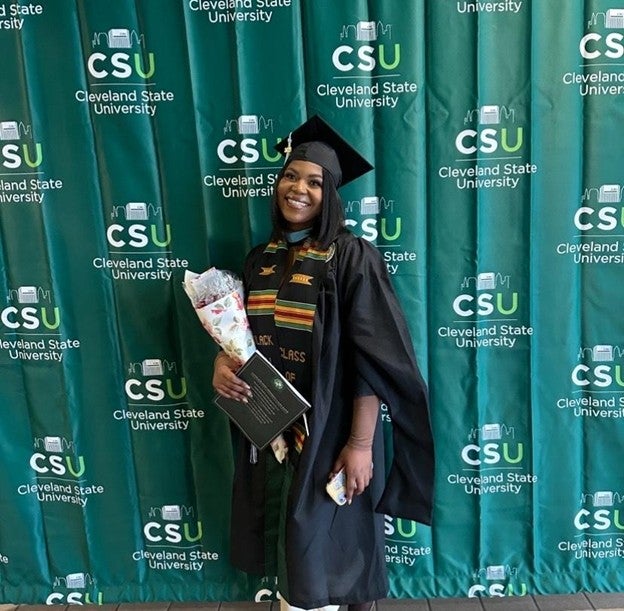
The Education Department at Cleveland State University is most wonderful! From my first semester with professor James Moore to Claire Hughes-Lynch, Anne Galletta, Roland Pourdavood, Bob Ross, and ending with Christine O’Neill, Anne Price, and Amanda Yurick, I lacked nothing. The most valuable gift that CSU has to offer are these people. I’ve learned from them how to be a competent educator, an effective leader, and a compassionate woman. Dr. Yurick instilled in me a passion for evidence-based practice in the field - which Dr. Price paved a way for me to apply and which Chris O’Neill guided me through. Because of the Education Department at Cleveland State, I began working as an educator two days after graduation. I’m extremely thrilled to be a graduate of CSU and to start my career: changing lives by empowering minds.
Frequently Asked Questions
Can I get the license first and finish the Master’s degree later?
Yes! Licensure courses can be completed first and you may obtain a license prior to finishing the Master’s degree.
How many credits can I transfer from another institution? Can undergraduate classes count toward graduate credits?
Nine graduate credits can be transferred from another institution, pending course relevancy evaluations and provided they have been taken within the past 10 years.
Do I have to write a thesis for this master’s degree?
No! Although a thesis is an option for a culminating experience, we offer a fully online clinical capstone course for one credit hour to be completed during the final semester of course work.
Can I get licensed to teach both Mild/Moderate and Moderate/Intensive Disabilities?
Yes! Moderate to Intensive licensure includes the same course work as Mild/Moderate licensure with two additional courses (6 credit hours)
Professional Licensure Disclosures
Cleveland State University's education programs that lead to licensure and/or endorsements meet the requirements of the state of Ohio only. Students who are seeking licensure or endorsement in other states should note that each state is responsible for establishing licensure requirements, which vary from state to state and can change at any time. Find more information on requirements in different states on our State Authorization and Professional Licensure page.